Zendesk Custom Agents for Commerce
What Agent Builder changes, and what it still needs from your commerce stack
On 14 September 2026 Zendesk introduced Specialized AI Agents - and made commerce the launch industry. If you run eCommerce support on Zendesk, two of those words now matter enormously — Industry Agents and Custom Agents. Here is what each one is, which one your team should be building, and the part Zendesk cannot ship for you.
What Zendesk actually shipped
Zendesk's framing is deliberately blunt. "The era of generic, one-size-fits-all AI agents is over," said Shashi Upadhyay, President of Product, Engineering and AI. "The best agents are specialists: deeply grounded in the work, the industry, and the business they serve."
Specialized AI Agents are described by Zendesk as purpose-built Zendesk Custom Agents for the work that matters most to a specific business or industry, combining industry expertise with each company's own knowledge, workflows and connected systems to take action and automate up to 80% of workflows. They come in two forms:
- Industry Agents — built for the work businesses within a specific industry have in common. The launch industry is commerce, with agents that help customers shop, manage orders, process returns and exchanges, resolve delivery issues and handle refunds. They connect to Shopify, Narvar, Stripe and Riskified out of the box. Financial services, media and technology are slated to follow.
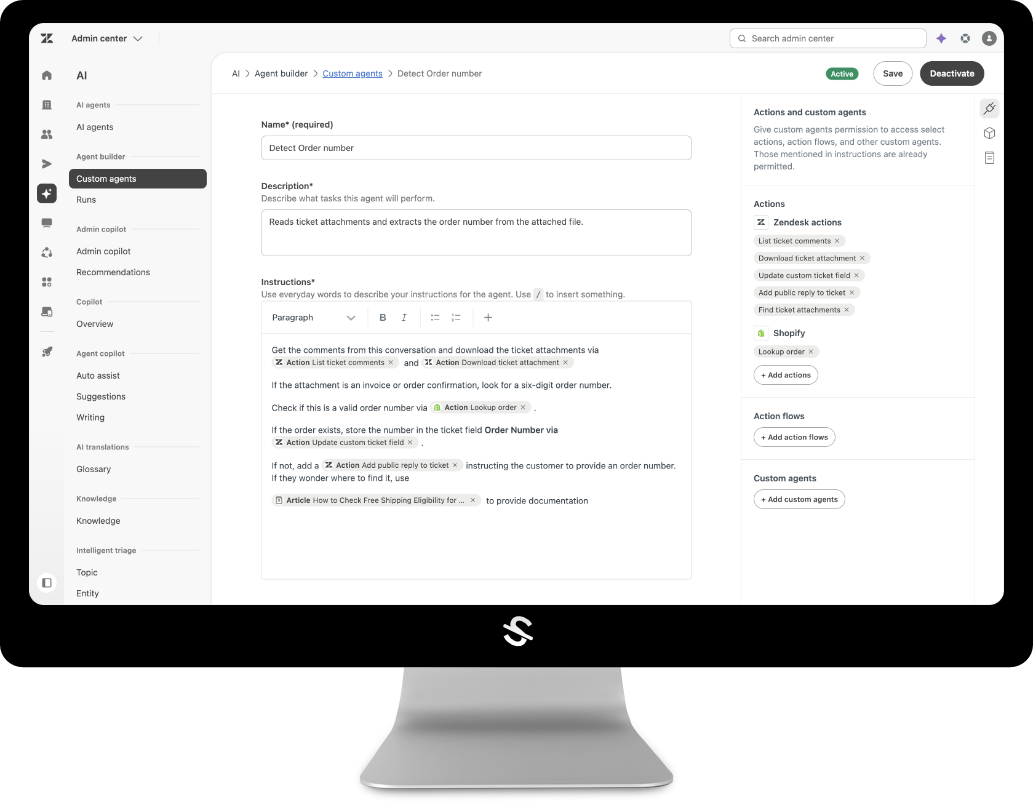
- Custom Agents — agents you build around your own processes, policies and expertise, created in Agent Builder, Zendesk's no-code environment for creating, testing and deploying agents. Custom Agents went into early access in May 2026 and Zendesk reports more than a million Zendesk Custom Agent executions inside the first seven weeks.
Both can run inside Zendesk or in other service environments including Salesforce and ServiceNow, and both sit under the wider Autonomous Service Workforce vision Zendesk set out at Relate 2026.
Much of this is still rolling out through early access. For early access (EAP) to the agnoStack functionality behind it, or a second opinion on which agent type fits your commerce stack, reach out to info@agnostack.com.
Industry Agent or Custom Agent?
Most retailers will end up with both, but the dividing line is clean.
An Industry Agent is the fastest route to the universal post-purchase intents — where is my order, I need to return this, my delivery is late. If your stack is Shopify plus the named partners, you get a long way with almost no configuration. That is a genuinely good deal and you should take it.
A Custom Agent is what you need the moment the answer depends on something Zendesk does not ship a connector for. In practice, that is most mid-market and enterprise commerce stacks:
- You are on Magento, Adobe Commerce, commercetools, BigCommerce, WooCommerce or Elastic Path rather than (or as well as) Shopify.
- Your subscriptions live in Recharge, Stay.ai or Paywhirl; your loyalty in Rivo, Yotpo or Smile.io; your reviews, returns and marketing automation somewhere else again.
- You run multiple storefronts, brands or regions on different platforms.
- The answer depends on data that only exists in your ERP, WMS or a homegrown service.
Zendesk's own words for this are precise: Custom Agents handle deep, multi-system reasoning on behalf of AI and human agents, doing the middle and back office work needed to reach a resolution. Multi-system reasoning is only as good as the systems it can reach.
What a Custom Agent needs from your commerce stack
Agent Builder gives you the reasoning, the testing harness and the deployment path. What it does not give you is a live, normalized view of a commerce back office it has never seen. Three things have to be true before a Zendesk Custom Agent can resolve rather than escalate:
- It can read the record. Order, fulfillment, shipment, subscription, loyalty and payment state, at the moment of the conversation — not a nightly sync.
- It can act on the record. Refund, reissue, edit before fulfillment, skip a delivery, start a return. An agent that can only describe a problem has not resolved anything.
- It behaves the same across platforms. If the same intent has to be rebuilt per storefront, you are maintaining one agent per platform rather than one agent.
This is exactly the layer agnoStack provides: one normalized commerce surface across platforms and the add-on providers around them, exposed to your human agents and to your automation alike.
Building your first Custom Agent
- Pick one intent with volume and an unambiguous success test. Order status is the classic, because "did the customer get their tracking?" cannot be argued about.
- Write the resolution path end to end — including what happens when the data is missing or the order cannot be matched.
- Wire the data and the actions before you tune a single prompt.
- Set the handoff. Every automated path needs an exit that carries full context into the ticket.
- Test in Agent Builder against real transcripts, not invented ones.
- Launch to a slice of traffic, measure for two weeks, then add the next intent.
Guardrails worth setting first
- Bound the money. Refunds, credits and order edits above a threshold route to a human.
- Never guess an order. Uncertain identity or order matching is an escalation, not a confident answer about the wrong purchase.
- Cap the loop. Two failed attempts on the same question is a handoff.
- Keep an audit trail so agents and auditors can reconstruct every automated action.
Measuring what matters
Zendesk's 80% figure is a workflow-automation claim, not a promise about your queue. Track full resolution rate — conversations closed with no human touch and no reopen within seven days — segmented by intent, alongside CSAT on automated conversations and handoff quality. A Custom Agent that fully resolves 70% of order-status contacts and hands off everything else cleanly beats one claiming 40% across the board.
Building Custom Agents for Zendesk and want to chat with some experts? See how Zendesk action flows reach your commerce back office, or read agnoStack’s primer on agnoStack for Zendesk AI Agents. Then contact agnoStack or schedule a demo. For early access (EAP) to agnoStack's upcoming functionality in this area, reach out to info@agnostack.com.
Empowering retailers
of all types & sizes to provide faster, more seamless and more intuitive customer support regardless of software stack.